Ch07 Process Environment
C Process Start and Termination

Start-up
[Kernel loads program with execve()]
    ↓
_start          // in crt1.o
    ↓
__libc_start_main
    ↓
(run initializations)
    ↓
main
Termination
#include <stdlib.h>     // specified by ISO C
void exit(int status);  // cleanup: fclose all open streams, call atexit handlers
void _Exit(int status);

#include <unistd.h>     // specified by POSIX.1
void _exit(int status);
explicit call of exit(status) from main()
main()
    ↓
exit(status) [libc] (bypass __libc_start_main())
    ↓
__run_exit_handlers()
    ↓
call functions registered with atexit() (in reverse order)
    ↓
flush/close stdio
    ↓
_exit(status) [libc → syscall]
    ↓
kernel exit_group()
    ↓
process ends
return from main()
main() -> return to __libc_start_main()
                            ↓
                    exit(status) [libc]
                            ↓
                (the rest is same to above)
explicit call of _exit(status) from main
No much cleanup work.
main()
    ↓
_exit(status) [libc → syscall]
    ↓
kernel exit_group()
    ↓
process ends
Call atexit() registered handlers in reverse order
static char *p1 = "Bye!";
static char *p2 = "Bye!";

void exit_handler_1(void);
void exit_handler_2(void);

int main(int argc, char *argv[]) {
  if (atexit(exit_handler_1)) my_perror("atexit: exit_handler_1");
  if (atexit(exit_handler_1)) my_perror("atexit: exit_handler_1");
  if (atexit(exit_handler_2)) my_perror("atexit: exit_handler_2");
  if (argc > 1) {
    p1 = argv[1];
    if (argc > 2) {
      p2 = argv[2];
    }
  }
  printf ("argc = %d\n", argc);
}

void exit_handler_1 (void) {
  printf("EXIT_HANDLER_1: %s\n", p1);
}

void exit_handler_2 (void) {
  printf("EXIT_HANDLER_2: %s\n", p2);
}

/*
:!Debug/procenv/exit_handler_test 再见 Adios
argc = 3
EXIT_HANDLER_2: Adios
EXIT_HANDLER_1: 再见
EXIT_HANDLER_1: 再见
 */
Command Line Arguments
argv
argv is a pointer to a null‐terminated array of character pointers to
null‐terminated character strings. Both ISO C Standard and POSIX Standard
requires applications shall ensure the last member of argv is a null
pointer.
Iteration over argv
/* test_main_argv.c */

// argv[0]: program name, argv[1] ~ argv[argc-1]: arguments, argv[argc]: NULL

int main(int argc, char *argv[]) {
  // 1.
  for (int j = 0; j < argc; j++) printf("argv[%d]: %s\n", j, argv[j]);
  printf("---\n");

  // 2.
  for (int j = 0; argv[j] != NULL; j++) printf("argv[%d]: %s\n", j, argv[j]);
  printf("---\n");

  // 3.
  for (char **p = argv; *p != NULL; p++) printf("p: %p, *p: %s\n", p, *p);
  printf("---\n");

  // print argc arguments + 1.
  for (int j = 0; j <= argc; j++) printf ("argv[%d]: %s\n", j, argv[j]);
  printf("---\n");
}

/*
Debug/procenv/test_main_argv a1 a2
argv[0]: Debug/procenv/test_main_argv
argv[1]: a1
argv[2]: a2
---
argv[0]: Debug/procenv/test_main_argv
argv[1]: a1
argv[2]: a2
---
p: 0x7ff7b81901d8, *p: Debug/procenv/test_main_argv
p: 0x7ff7b81901e0, *p: a1
p: 0x7ff7b81901e8, *p: a2
---
argv[0]: Debug/procenv/test_main_argv
argv[1]: a1
argv[2]: a2
argv[3]: (null)
---
 */
Interpreter file
Read the man page execve(2)
If the first two bytes of a script are #! (shebang), and they’re
followed by an interpreter, it is an interpreter file (shebang
script).
#! interpreter [ optional-argument ...]
...
When it is executed via ./a.sh or execve(interpreter_file_path, argv, envp)
- The kernel locates and load the interpreter after the shebang
- The arguments to be passed to interpreter are built in this order:
- the zeroth argument: the interpreter itself
- the first (second, ..) argument: the optional arguments after the interpreter
- the script file path (or the path passed to
execve()) - the original arguments passed to the script or
execcall (argv)
- The kernel calls a second
execve()with the interpreter and arguments.- if the interpreter is an executable binary, the kernel will setup
process image and jump to
_startin user process. - if the interpreter is also an shebang script, the kernel goes
back to step 1, recursively. (Linux: BINPRM_MAX_RECURSION=4, if exceeded,
failed with
ELOOP)
- if the interpreter is an executable binary, the kernel will setup
process image and jump to
NOTE: a. The kernel overrides the first argument passed to the shebang script with the script path. b. On Linux the kernel only supports one optional shebang argument – it’s just one contiguous string after the interpreter path, up to newline argv[0]: Debug/procenv/printargv argv[1]: interp_arg1 interp_arg2 <- Linux: the rest of the line after the interpreter argv[2]: ./tmp/data/procenv/interpreter.file …
- Example 1:
execve(2)with shebang interpreter file
/* execve.c */

int main(int argc, char *argv[]) {
  static char *newargv[] = {"this will be overridden", "hello", "world", NULL};
  static char *newenviron[] = {NULL};

  if (argc != 2) {
    fprintf(stderr, "Usage: %s <file-to-exec>\n", argv[0]);
    exit(EXIT_FAILURE);
  }

  execve(argv[1], newargv, newenviron);
  perror("execve"); /* execve() returns only on error */
  exit(EXIT_FAILURE);
}

/*
cat ./tmp/data/procenv/interpreter.file
#! Debug/procenv/printargv interp_arg1 interp_arg2

Debug/procenv/execve ./tmp/data/procenv/interpreter.file
argv[0]: Debug/procenv/printargv
argv[1]: interp_arg1
argv[2]: interp_arg2
argv[3]: ./tmp/data/procenv/interpreter.file    <-- overridden by kernel
argv[4]: hello
argv[5]: world
*/- Example 2:
execl(3)with shebang interpreter file
int main(int argc, char *argv[]) {
  // exec: shebang interpreter file
  if (execl("./tmp/data/procenv/interpreter.file", "this will be overridden", "arg1", "arg2", (char*)0) < 0)
    my_perror("execl error");
  return 0;
}

/*
:!Debug/procenv/exec_interpreter_file
argv[0]: Debug/procenv/printargv
argv[1]: myecho_arg1
argv[2]: myecho_arg2
argv[3]: ./tmp/data/procenv/interpreter.file
argv[4]: arg1
argv[5]: arg2
*/- Example 3:
execl(3)with executable
int main(int argc, char *argv[]) {
  // exec: executable
  if (execl("./Debug/procenv/printargv", "this will NOT be overridden", "arg1", "arg2", (char*)0) < 0)
    my_perror("execl error");
  return 0;
}

/*
Debug/procenv/exec_executable
argv[0]: this will NOT be overridden
argv[1]: arg1
argv[2]: arg2
 */
Environment
Memory Layout
Logical layout of a process’s virtual memory.
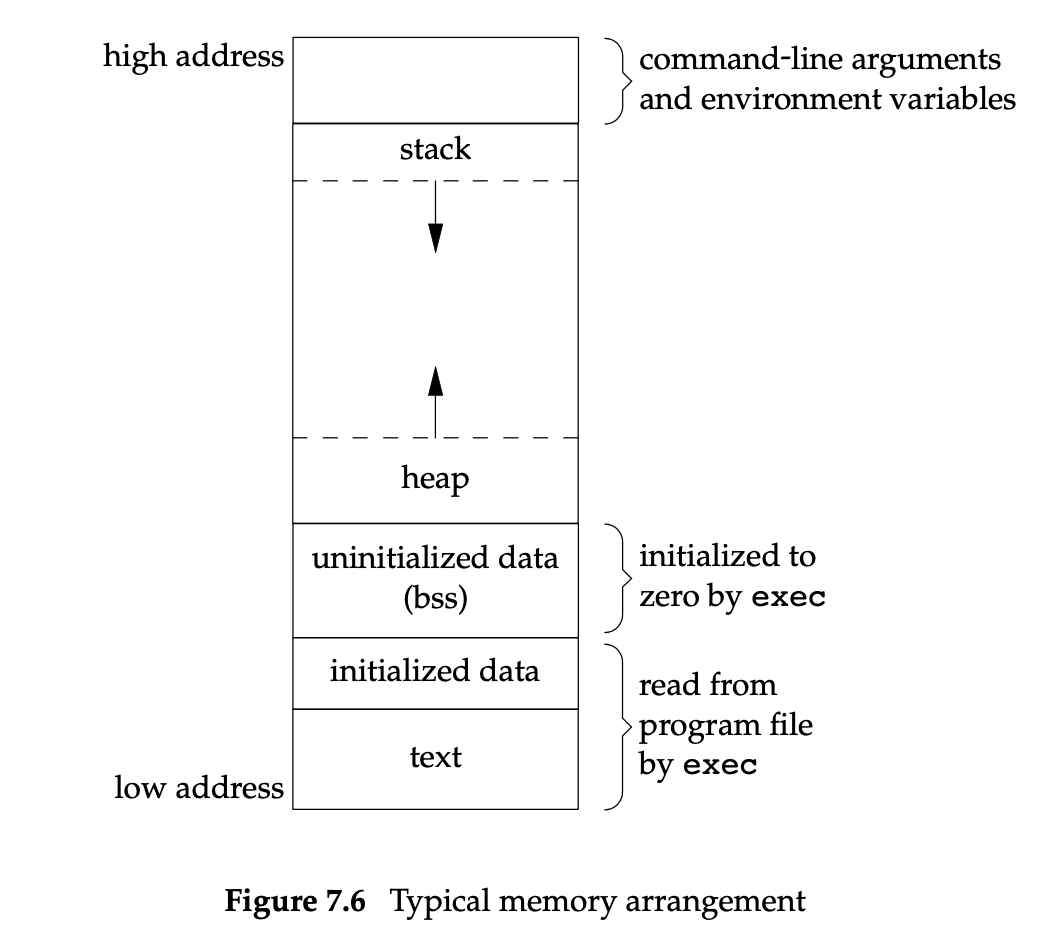
Stack Segment
Automatic storage duration, variables are declared in a function:
- Automatic allocation on stack when function is invoked and deallocation when it returns.
- Uninitialized variables contain garbage values.
Data Segment
Global or static storage duration, variables declared globally or as static in a function:
- if initialized, located at initialized data segment
- if not initialized, located at Block Start by Symbol (BSS) data segment and zero-initialized by compiler (e.g. int: 0, float: 0.0f, void*: NULL)
- allocation when the program starts and persists for the entire duration of the program’s execution.
NOTE:
When an array is partially initialized, all unspecified elements are zero-initialized, no matter what storage duration the array is in.
- Full:
int numbers[5] = {10, 20, 30, 40, 50}; - Partial (rest zero-initialized):
int numbers[5] = {10, 20}; - Omitted size (compiler determines):
int numbers[] = {10, 20, 30}; - Designated initializers (C99+):
int numbers[5] = {[2] = 30, [0] = 10};
Inspect an executable binary layout (size or otool)
#
# On Linux:
# > size ./Debug/procenv/printargv ./Debug/procenv/execve
#    text    data     bss     dec     hex filename
#    1392     584       8    1984     7c0 ./Debug/procenv/printargv
#    1815     648      16    2479     9af ./Debug/procenv/execve
VIRT/RSS/Shared/Private’s Perspective of Memory Layout of a Process
When a process runs, its memory can be divided into:
- Virtual Memory
- The total address space the process has allocated.
- Includes code, heap, stack, shared libs, memory-mapped files, etc.
- Can be much larger than physical RAM, since the OS uses virtual memory.
- Resident Set Size(RSS)
- The portion of that virtual memory actually loaded into physical RAM.
- i.e. pages that are “resident” in memory, not swapped out.
- This is what really matters for system memory pressure.
- A memory leak increases RES steadily.
- If RES grows too large, the system may swap or kill processes.
- A big VIRT but small RES is usually harmless (lots of mappings but not much RAM used).
- Shared vs Private
- Part of RSS may be shared (libraries, shared memory).
- The rest is private (your heap, stack,
malloc()ed).
Example:
  PID USER  PR  NI  VIRT   RES   SHR S %CPU %MEM TIME+ COMMAND
12345 you   20   0  120m   40m  5.0m S  0.0  1.2  0:00 myprog
Relationship of the two layouts
- APUE layout = blueprint of virtual address space.
- RSS/VIRT/SHR = runtime measurements overlayed on that blueprint.
A simplified combined diagram
High Addresses
 ┌──────────────────────────────┐
 │ Args + Environment           │
 │   - small, negligible VIRT/RSS
 ├──────────────────────────────┤
 │ Stack (grows down)           │
 │   - VIRT: reserved per thread
 │   - RSS: frames actually used
 ├──────────────────────────────┤
 │ Memory-mapped regions        │
 │   - shared libs, files, anon
 │   - VIRT: can be large
 │   - RSS: only touched pages
 ├──────────────────────────────┤
 │ Heap (malloc/new, grows up)  │
 │   - VIRT: expandable
 │   - RSS: grows as you touch allocated memory
 │   - Leaks → RSS growth
 ├──────────────────────────────┤
 │ Data (globals, statics)      │
 │   - VIRT: .data + .bss
 │   - RSS: when loaded into RAM
 ├──────────────────────────────┤
 │ Text (code)                  │
 │   - read-only, shareable
 │   - VIRT: fixed
 │   - RSS: only executed pages
 └──────────────────────────────┘
Low Addresses
Memory allocation
#include <stdlib.h>
void *malloc(size_t size);
void *calloc(size_t nobj, size_t size);
void *realloc(void *ptr, size_t newsize);
                    // All three return: non-null pointer if OK, NULL on error

void free(void *ptr);malloc: memory allocationcalloc: contagious allocation, array of elementsrealloc: whenptrisNULL,rallocismalloc
The allocation allocates more space than requested and use the additional space for record-keeping (size of the block, a pointer to the next allocated block and the like). Writing past the end or before the start of an allocated area would overwrite the record-keeping information of another block.
The allocation routines are usually implemented with the sbrk(2) syscall.
This call expands (or contracts) the heap of the process. However, the freed
space is not usually returned to the kernel; instead, it is kept in
the malloc pool.
free: Find memory metadata by the help ofptrand know the size of memory to be freed.
Memory Leak
For long-running processes (servers, daemons, GUI apps), unreleased allocations accumulate and finally cause real memory leak problem.
Example: It’s the caller’s responsibility to free() malloc()ed strings.
char *make_str(void) {
    char *p = malloc(100);
    if (!p) return NULL;
    strcpy(p, "hello");
    return p;   // caller must free()
}

int main() {
    char *s = make_str();
    // ... do something with s
    free(s); // The caller is responsible for this call
    return 0;
}
setjmp and longjmp
goto is a local jump, jump in the same function (same stack frame). setjmp
and longjmp can jump across stack frames. longjmp causes the stack to be
unwound back to the function where setjmp is called, throwing away
the after stack frames.
#include <setjmp.h>
int setjmp(jmp_buf env);
  // Returns: 0 if called directly, nonzero if returning from a call to longjmp

void longjmp(jmp_buf env, int val);
Incorrect usage of an automatic variable
FILE *
open_data(void)
{
  FILE    *fp;
  char    databuf[BUFSIZ];  /* setvbuf makes this the stdio buffer */ <-- err
  if ((fp = fopen("datafile", "r")) == NULL)
      return(NULL);
  if (setvbuf(fp, databuf, _IOLBF, BUFSIZ) != 0)
      return(NULL);
  return(fp);     /* error */
}
databuf needs to be allocated from global memory, either statically (static
or extern) or dynamically (one of alloc functions).
getlimit and setlimit
#include <sys/resource.h>
int getrlimit(int resource, struct rlimit *rlptr);
int setrlimit(int resource, const struct rlimit *rlptr);
                                 //   Both return: 0 if OK, −1 on error

struct rlimit {
  rlim_t  rlim_max;  /* hard limit: maximum value for rlim_cur */
  rlim_t  rlim_cur;  /* soft limit: current limit */
};| API / Header | Example | Scope | Changeable? | Source |
|---|---|---|---|---|
<limits.h> | INT_MAX, OPEN_MAX | Compile-time / C | No | Compiler/C lib |
sysconf(_SC_...) | _SC_OPEN_MAX | Runtime query | No (read-only) | Kernel/config |
<sys/resource.h> rlimits | RLIMIT_NOFILE, RLIMIT_DATA | Runtime per-process | Yes (soft/hard) | Kernel |